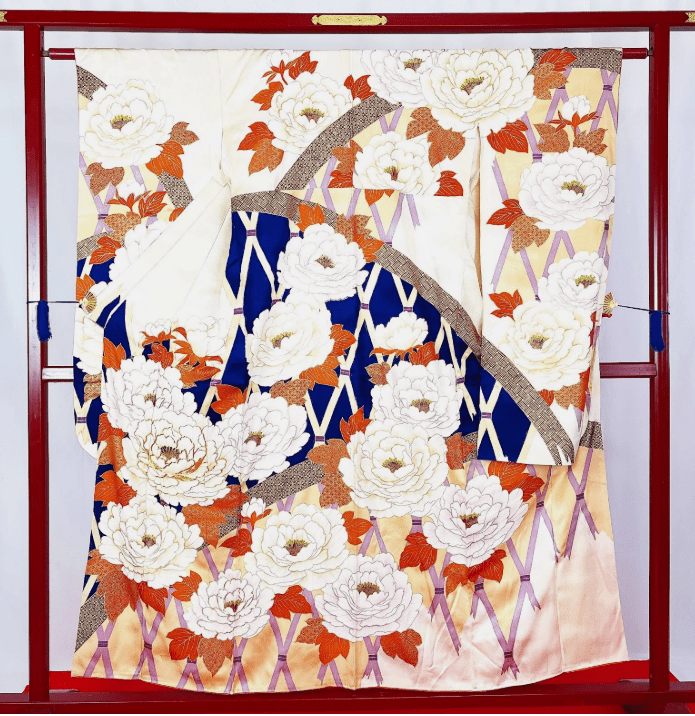
By Susie. Information accompanying the display at Walkley Community Centre, 6 July 2025.
A kimono (着物) literally a ‘thing to wear’ is considered to be a very personal item of clothing. Kimonos are often family heirlooms that need to be folded in a specific way and stored carefully when not in use. They are usually made from a single bolt of fabric about 36-42cm wide by 11.5 metres called a ‘Tan’. (14-17 inches by 38 feet). If purchased new they can be very expensive items of clothing.
Kimonos are usually hand-sewn and need specialist dry-cleaning – which involves the stitching of the kimono being unpicked and re-sewn once the bolt of material has been cleaned and stretched – a costly and lengthy process.
Typically, several skilled craftsmen would be involved in the making of one garment depending upon whether the design incorporated shibori – a very intricate type of tie dye, yuzen – hand painted designs, shishu – embroidery etc.
Types of kimono and typical occasions when worn:
- Gofuku – a term used for formal clothing, generally made of silk.
- Homongi – formal visiting wear with elaborate designs on the sleeves and around the bottom of the kimono.
- Uchikake – a padded outer kimono that trails along the floor. Worn by a bride – usually white or red and heavily embroidered with auspicious symbols (cranes, fans, pine trees, chrysanthemums).
- Tomesode – the most formal kimono with kamon (family crests – would have 3 or 5 crests) usually worn by married women at weddings and in the New Year.
- Mofuku – a formal black kimono with 5 kamon, typically worn by immediate family members at funerals.
- Iromuji – a coloured kimono (typically one colour) mainly worn for tea ceremony.
- Furisode or Nagasode (swinging sleeves) – Seijin shiki (Coming of Age ceremony), worn by unmarried women.
- Odori – Nihon buyo, stage performances.
- Ro – a more lightweight, cooler summer kimono made of fine gauze.
- Yukata – more informal cotton garment worn at summer festivals, when visiting hot springs (onsen), in lessons by students studying Japanese dance (Nihon Buyo) and for sleeping (nemaki). Yukata are reasonably priced and tend to be made of printed fabric.
Patterns and designs are determined by the season (and even month) when a kimono should be worn:
- Spring – plum blossom, cherry blossoms, butterflies, mist, magnolia, peaches, lilies, irises
- Summer – flowing water, hollyhocks, wisteria, morning glory
- Autumn – maple leaves, ginkgo, ivy, persimmons, drums, chrysanthemums
- Winter – pine trees, bamboo, camellia, snowy landscapes, peony, paulownia
Haori (羽織) – a kimono jacket worn over the kimono) – often decorated with designs in shibori – very intricate tie dye.
Obi (帯) ‘something that is tied’. A sash usually made from silk or brocade. Often more expensive to buy new than a kimono. They are versatile in the sense that they can be tied in many different ways. The most typical style is the ‘taiko-musubi’ (tied in the drum-shaped) manner.
Types of obi:
- Maru – a formal, heavier weight brocade obi, usually about 30cm wide and 350-400cm long.
- Fukuro – a slightly less formal, lighter weight brocade obi, first produced in the 1920s – usually about 30cm wide and 350-400cm long.
- Nagoya – first produced in the early 20th century and the most commonly worn everyday obi divided into two pieces, partly pre-tied and easier to wear.
- Hanhaba or Hitoe – a narrow half-width obi worn with yukata or everyday kimono.
Obi designs and the significance of symbols
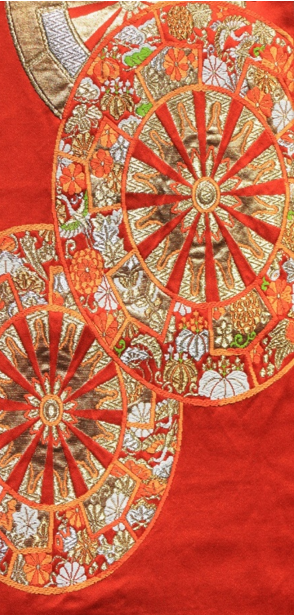
Common motifs represent the seasons, good luck, long life, or nature generally.
● Bamboo ‘take’ (竹) – strong, resilience, long life
● Butterflies ‘chōchō’ (蝶蝶) – beauty, longevity, fleeting nature of life

● Carp ‘koi’ (鯉) – perseverance, prosperity
● Ceremonial cartwheel ‘sokuten’ (側転) – circle of life
● Cherry blossom ‘sakura’ (桜) – Spring, transient beauty
● Chrysanthemum ‘kiku’ (菊) – Autumn, imperial symbol, regal beauty, longevity
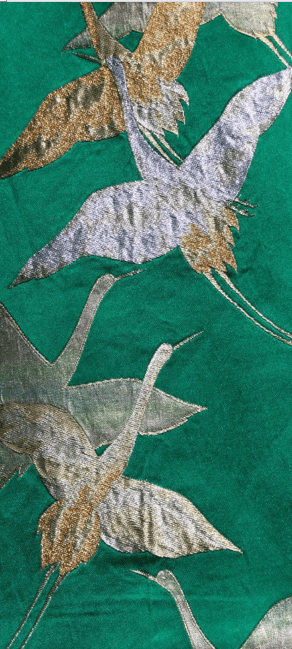
● Cranes ‘tsuru’ (鶴) – longevity, harmony and fidelity
● Dragons ‘tatsu’ (龍) – strength, protection, good fortune
● Drum ‘taiko’ (太鼓) – joy, peace
● Family crests ‘Kamon’ (家紋)
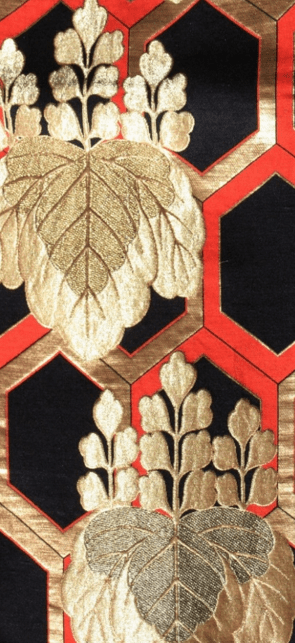
● Hexagons ‘rokkakkei’ (六角形) – turtle shell, long life
● Hollyhocks – ‘tachi aoi’ (立葵) – connected to the Shinto religion

● Iris – ‘airisu no hana’ (アイリスの花) – protection from evil spirits
● Mountains ‘yama’ (山)– sacred places between heaven and earth
● Paulownia tree ‘kiri’ (桐) – imperial symbol, prosperity
● Peony ‘botan’ (牡丹) – good fortune and ageless beauty
● Phoenixes (フェニックス) – peace and fidelity
● Pine trees ‘matsu’ (松) – Winter, long life (as they are evergreen)
● Plum blossom ‘ume’ (梅) – peace, longevity, renewal, perseverance
● River ‘kawa’ (川) – continuity, the future
● Scrolls ‘makimono’ (巻物) – learning, knowledge and a cultured life
● Waves ‘nami’ (波) – the ebb and flow of life

● Wisteria ‘fuji’ (藤) – synonymous in Japanese with ‘undying’, long life
 Bamboonic